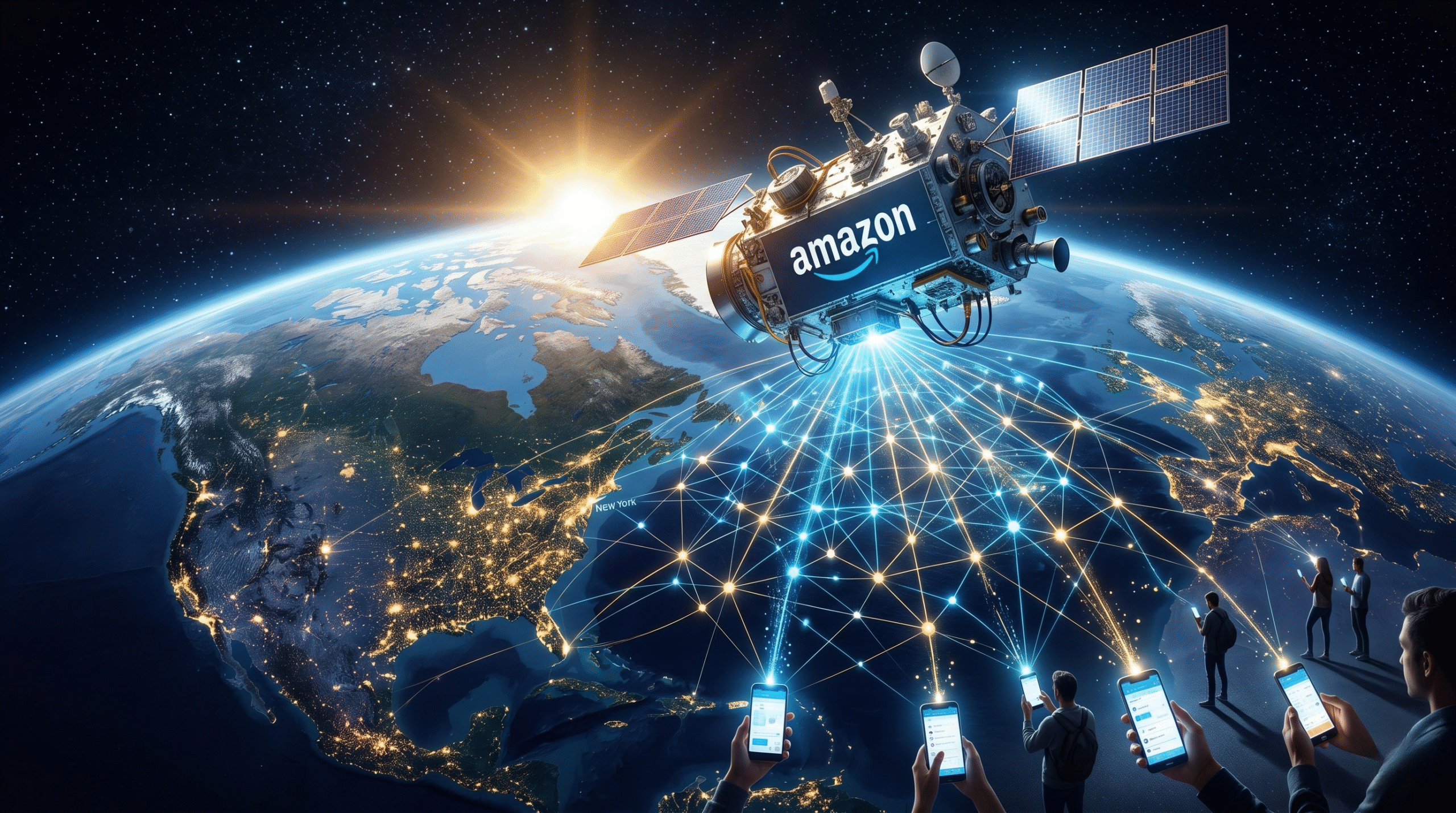
Have you ever looked up at the night sky and wondered just how many satellites are buzzing around up there? Well, it’s about to get a lot more crowded. In a massive, industry-shaking move, Amazon has officially agreed to acquire the satellite communications company Globalstar in a jaw-dropping $11.57 billion deal.
If you are wondering why an e-commerce and cloud-computing giant is spending billions on satellites, the answer is simple: Space Internet. Amazon is tired of watching Elon Musk’s SpaceX and its Starlink network run away with the global satellite internet market. They want a piece of the pie, and they want it now. Let’s break down everything you need to know about this massive acquisition in a simple, conversational, and detailed way.
1. The Deal Breakdown: What Exactly Just Happened?
When big tech companies make moves, they don’t do it quietly. Here are the pointed details of the acquisition that had the stock market buzzing:
- The Price Tag: Amazon is paying roughly $11.57 billion for Globalstar.
- The Payout for Shareholders: Globalstar shareholders are getting a sweet deal. They have the option to receive either $90 in cash or 0.3210 shares of Amazon common stock for each Globalstar share they own.
- The Stock Market Reaction: Right after the rumors and the official announcement, Globalstar’s stock skyrocketed by over 9% in premarket trading. (It had already doubled in value over the past year!). Amazon’s stock also saw a healthy 1% bump.
- The Timeline: The deal isn’t going to happen overnight. It’s expected to officially close in 2027, assuming all the government regulators and shareholders give it the green light.
Why it matters: This isn’t just Amazon buying a small startup. This is Amazon buying an established player with vital technology, spectrum rights, and hardware already orbiting the Earth.
2. Who is Globalstar? (And Why Are They So Important?)
If the name Globalstar sounds vaguely familiar, it’s probably because you’re carrying their technology in your pocket right now. Based in Covington, Louisiana, Globalstar is not a newcomer to the space race.
Here is what makes them a heavyweight:
- The Satellites: They currently operate about two dozen satellites in Low-Earth Orbit (LEO).
- The Apple Connection: Globalstar is the secret sauce behind Apple’s “Emergency SOS via satellite” feature. If you have a newer iPhone and get stranded in the wilderness without cell service, it’s a Globalstar satellite that picks up your distress signal and sends it to emergency responders.
- The Spectrum: In the telecommunications world, “spectrum” (the radio frequencies used to transmit data) is like digital real estate. Globalstar owns incredibly valuable spectrum rights that allow devices to connect to space without needing giant, ugly satellite dishes.
3. Why Did Amazon Open Its Wallet? (The Master Plan)
Amazon already has its own satellite internet project, known as Project Kuiper (often referred to as Amazon’s LEO push). So, why buy Globalstar?
The Regulatory Ticking Clock
Amazon has promised the US Federal Communications Commission (FCC) that it will launch a massive network of roughly 3,200 satellites into space by 2029.
- The Catch: The FCC requires Amazon to have at least half of those satellites fully operational by a strict deadline in July 2026.
- The Solution: Building and launching satellites takes time. By buying Globalstar, Amazon instantly inherits an existing network, valuable tech, and the capability to speed up their own deployment timeline.
Direct-to-Device (D2D) Connectivity
This is the holy grail of modern telecom. Instead of requiring users to buy a $500 satellite dish to get internet (like you do with Starlink currently), D2D means the satellite talks directly to your everyday smartphone.
- Globalstar is a pioneer in D2D technology.
- Amazon plans to roll out its own D2D mobile internet services by 2028. Buying Globalstar essentially lets them skip the line and get the technology right away.
4. The Space Heavyweights: Amazon vs. Starlink
To understand this acquisition, you have to look at the massive shadow cast by Elon Musk. Starlink (a division of SpaceX) is the undisputed king of space internet right now. Amazon is throwing billions of dollars at the problem just to catch up.
Let’s look at how the two rivals compare right now:
| Feature / Metric | SpaceX’s Starlink | Amazon + Globalstar |
| Active Satellites in Orbit | ~10,000 units | ~200 (Amazon) + ~24 (Globalstar) |
| Global Users | Over 9 million users | Commercial service starting later this year |
| Primary Advantage | Massive scale, proven tech, in-house rockets | AWS integration, massive capital, D2D tech |
| Smartphone Connection | Testing phase for D2D | Proven D2D via Apple’s Emergency SOS |
| Launch Vehicles | They own their own rockets (Falcon 9) | Must rely on 3rd party rockets (Blue Origin, ULA) |
The Bottom Line: Starlink has a massive head start. They have millions of paying customers and thousands of satellites. But Amazon has practically infinite money, the world’s largest cloud infrastructure (Amazon Web Services), and now, Globalstar’s direct-to-device expertise.
5. What Happens to Your iPhone’s Emergency SOS?
When news broke that Amazon was buying the company that powers Apple’s safety features, iPhone users understandably panicked. Would Amazon shut down Apple’s service to keep the tech for themselves?
The answer is No.
- The $1.5 Billion Stake: Apple had actually invested around $1.5 billion into Globalstar just last year to help them build a brand-new, 54-satellite network specifically for Apple services.
- The New Pact: Alongside the acquisition announcement, Amazon and Apple signed a parallel agreement. Amazon guarantees that they will continue to support and power the “Emergency SOS” and “Find My” satellite features for iPhone and Apple Watch users.
- A Rare Partnership: It is extremely rare to see fierce tech competitors like Amazon and Apple playing nicely, but the mutual benefits of this existing network were too big to ignore.
6. The Good, The Bad, and The Space Junk
While this deal sounds like a massive win for technology, it does come with a few asterisks. Industry analysts and space experts have pointed out several hurdles Amazon still faces:
The Rocket Bottleneck
You can build all the satellites you want, but you still have to get them into space.
- SpaceX uses its own rockets to launch Starlink satellites. It’s cheap, and they can launch every single week.
- Amazon has to rely on other companies (like Jeff Bezos’ Blue Origin, United Launch Alliance, and Arianespace). Right now, there is a global shortage of rocket launch capacity. Analysts warn that buying Globalstar does not fix Amazon’s struggle to actually get their hardware off the ground.
Kessler Syndrome (The Space Junk Problem)
As Reddit users and space enthusiasts quickly pointed out when the deal was announced, Earth’s orbit is getting dangerously crowded.
- If we have 10,000 Starlink satellites, 3,200 Amazon satellites, and thousands more from other countries, the risk of them crashing into each other rises.
- Kessler Syndrome is a theoretical scenario where one satellite crashes into another, creating debris that crashes into more satellites, creating an unstoppable chain reaction that could make leaving Earth impossible. As the “Satellite Wars” heat up, cleaning up space junk will become a massive priority.
7. What Does This Mean For Everyday Internet Users?
You might be thinking, “This is cool business news, but how does it actually affect me?”
Here is exactly how the Amazon-Globalstar deal will impact your daily life in the next 3 to 5 years:
- The Death of “Dead Zones”: With direct-to-device technology expanding, losing cell service on a road trip, in a national park, or during a natural disaster will soon become a thing of the past. Your phone will simply switch from a terrestrial cell tower to an Amazon or Starlink satellite in space.
- Cheaper Internet: Competition drives prices down. Right now, Starlink can charge premium prices because they are the only reliable game in town for remote internet. Once Amazon enters the market with full force, expect subscription costs to drop.
- Better Enterprise Connectivity: If you work in logistics, shipping, or agriculture, tracking assets across the globe will become incredibly cheap and highly accurate. Globalstar’s data and asset-tracking services will likely be integrated directly into Amazon Web Services (AWS).
- AI and Cloud Growth: Amazon will undoubtedly use this satellite network to push its AI tools and AWS cloud services to the most remote corners of the planet, allowing massive data transfers without needing underground fiber-optic cables.
Conclusion: A High-Stakes Gamble in the Stars
Amazon’s $11.57 billion acquisition of Globalstar is a loud, undeniable declaration of war in the satellite internet market. Elon Musk’s Starlink has enjoyed sitting on the throne unchallenged for years, but Amazon has just bought the ultimate shortcut to stay in the race.
By securing Globalstar’s spectrum, absorbing their existing satellites, and bringing direct-to-phone technology under the Amazon umbrella, Jeff Bezos’ empire is making sure they aren’t left behind on Earth.
The deal won’t officially close until 2027, and Amazon still has a mountain to climb when it comes to launching rockets and dodging space debris. But one thing is for sure: the battle for the future of the internet is no longer happening in underground cables. It’s happening 300 miles above our heads.