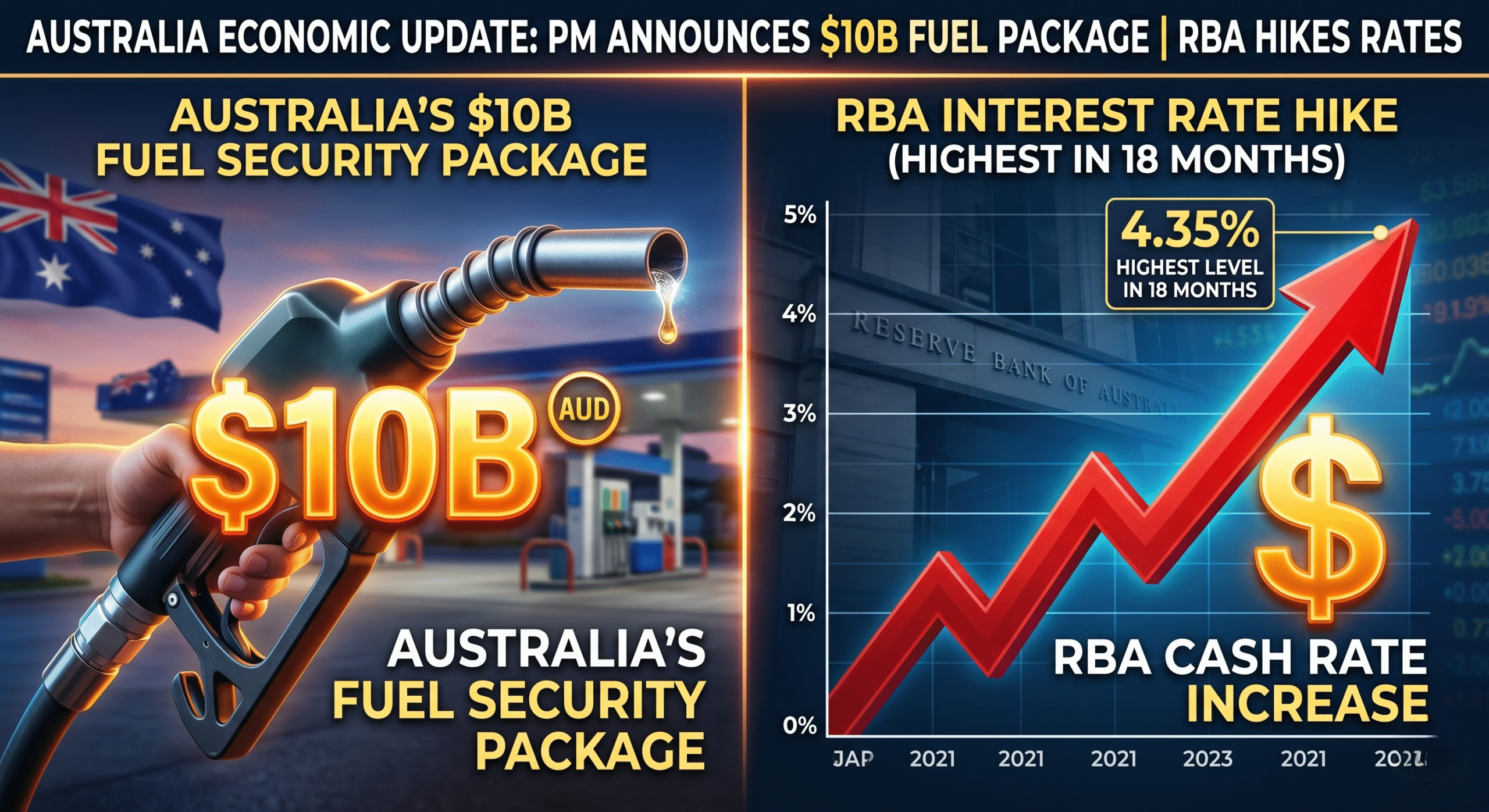
If you’ve been watching the news lately, you might feel like your wallet is being pulled in a dozen different directions. In a massive day for the economy, we’ve just been hit with a double-whammy of breaking news: the Prime Minister has announced a staggering $10 billion fuel security package, and almost simultaneously, the Reserve Bank of Australia (RBA) has hiked interest rates to their highest level in almost 18 months.
If your head is spinning with financial jargon, don’t worry. You aren’t alone. When politicians start throwing around words like “fiscal policy,” “cash rate,” and “strategic reserves,” it’s easy to tune out. But these two massive announcements are going to have a very real, tangible impact on your day-to-day life—from the price you pay at the pump to the amount that leaves your bank account for your mortgage each month.
Let’s skip the heavy economic textbook talk and break down exactly what has happened, why it’s happening, and most importantly, what it means for your household budget.
Breaking Down the $10 Billion Fuel Security Package
First, let’s talk about the big shiny number: $10 billion. The Prime Minister has announced this massive funding package strictly dedicated to “fuel security.” But what does that actually mean?
Imagine your household for a second. If you knew that the local supermarket might suddenly stop selling food next month, you’d probably start building a pantry of canned goods, right? You want to be secure in case the supply chain breaks.
On a national level, a country needs a reliable supply of fuel to keep the economy moving. Without diesel and petrol, trucks can’t deliver food to the supermarkets, tradies can’t get to job sites, and you can’t drive to work. Historically, Australia has relied very heavily on importing fuel from overseas. In a peaceful, highly connected world, that’s usually fine. But over the last few years, global conflicts, supply chain issues, and shipping delays have shown us just how vulnerable we are.
So, where is this $10 billion going?
- Building Strategic Reserves: The government is investing heavily in building massive storage tanks to hold emergency fuel. This ensures that if global supply chains freeze, the country doesn’t grind to a halt in a matter of weeks.
- Supporting Local Refineries: Instead of buying finished petrol from overseas, this package helps keep our domestic oil refineries open and operational, protecting thousands of local jobs.
- Future-Proofing: A portion of these funds will likely look toward transitioning our fuel networks to be more resilient, ensuring that we aren’t entirely at the mercy of global oil prices.
Ultimately, this is a defensive move. It’s the government buying a very expensive insurance policy for the nation’s economy.
The RBA Rate Hike Explained (The 18-Month High)
Now, let’s look at the other side of the coin: the Reserve Bank of Australia. The RBA has just announced an interest rate hike, bringing the official cash rate to its highest level in almost a year and a half.
Why does the RBA keep raising rates? To understand this, we have to talk about inflation. Think of inflation like a balloon that’s being blown up too fast. When there’s too much money floating around and people are buying things quicker than businesses can produce them, prices go up. We’ve all seen it—groceries, electricity, and eating out all cost noticeably more than they did a couple of years ago.
The RBA’s main job is to keep that balloon from popping. Their primary weapon to fight inflation is the interest rate. By raising interest rates, the RBA makes it more expensive to borrow money.
Here is how the domino effect works:
- The RBA raises the cash rate.
- Banks pass this on by raising the interest rates on variable mortgages and loans.
- Everyday Australians have to put more of their paycheck toward their mortgage.
- Because they are spending more on their house, they spend less at retail stores, restaurants, and on holidays.
- With fewer people buying things, businesses eventually have to lower or stabilize their prices to attract customers.
- The inflation balloon deflates.
Hitting an 18-month high means the RBA is sending a clear message: inflation is still a bit too stubborn, and they want to cool down the economy to get prices back under control.
The Economic Tug-of-War: Government vs. The RBA
If you look closely at these two announcements, you might notice something a bit funny. They seem to be pulling the economy in two completely different directions.
On one hand, the RBA is aggressively stepping on the brakes. They are raising rates to take money out of the economy and stop people from spending.
On the other hand, the Prime Minister and the government are stepping on the gas. They are injecting a massive $10 billion into the economy to build infrastructure and protect the fuel industry.
It’s an economic tug-of-war. The government wants to ensure the country is safe, resilient, and that people have jobs. The central bank wants to make sure your money doesn’t lose its value. This balancing act is exactly why managing a modern economy is so difficult.
What This Means for Your Wallet
Okay, enough macroeconomics. How does this double announcement change things at your kitchen table? Let’s break it down by how it impacts your daily life.
1. The Homeowner’s Headache
If you have a variable-rate mortgage, the RBA’s rate hike is going to sting. You can expect a letter or email from your bank in the coming days letting you know that your monthly repayments are going up. If you are already feeling the pinch, this 18-month high might force you to sit down and seriously rework your household budget. Less money for takeaways, more money for the bank.
2. The Renter’s Ripple Effect
If you don’t own a home, you might think you’ve dodged the RBA bullet. Unfortunately, that’s rarely the case. When landlords face higher mortgage repayments, they often look to pass those costs onto their tenants through higher rent. While they can’t raise it immediately if you are on a fixed lease, it’s something to prepare for when your renewal comes up.
3. The Driver’s Dilemma
Here is where the fuel security package comes into play. While the $10 billion package is great for long-term national security, it doesn’t mean petrol is suddenly going to drop to $1.20 a litre tomorrow. In fact, you might not notice an immediate drop at the pump at all. However, what this package does aim to do is prevent wild, disastrous price spikes in the future if a global crisis occurs. It’s about stability over cheapness.
4. The Saver’s Silver Lining
It’s not all doom and gloom! If you have cash sitting in a savings account or a term deposit, an RBA rate hike is actually great news for you. Banks will slowly raise the interest they pay you for keeping your money with them. It’s a great time to shop around and make sure your bank is offering a competitive high-interest savings rate.
Actionable Tips: How to Navigate the Changes
When big economic news drops, it’s easy to feel helpless. But there are practical steps you can take today to protect your finances.
- Review Your Mortgage: Don’t just accept the bank’s new rate. Call them up, tell them you are thinking of leaving, and ask for a better rate. If they say no, look at refinancing with another lender. There are still competitive rates out there if you are willing to look.
- Audit Your Subscriptions: With mortgage payments going up, find the money elsewhere. Cancel that streaming service you haven’t watched in three months, or the gym membership you aren’t using.
- Shop Smart for Fuel: Even with the government’s $10B package, fuel prices fluctuate wildly. Download a fuel-tracking app for your smartphone to find the cheapest petrol station in your suburb before you fill up.
- Chase High Savings Rates: If you are a saver, reward yourself. Log into your banking app and check your current interest rate. If it’s below 4.5% to 5%, you are leaving free money on the table. Move your cash to a bank that rewards you.