Have you ever been driving home late at night, your mind on your pillow or perhaps what’s left in the fridge, only to see something so bizarre it makes you slam on the brakes?
For Sydney resident Matt Arnold, a routine drive turned into a National Geographic moment—minus the camera crew and the safety of a glass screen. What he initially dismissed as a stray dead branch hanging from a power line turned out to be a high-stakes drama involving a predator, its lunch, and a very precarious piece of human infrastructure.
The “Dead Branch” That Moved
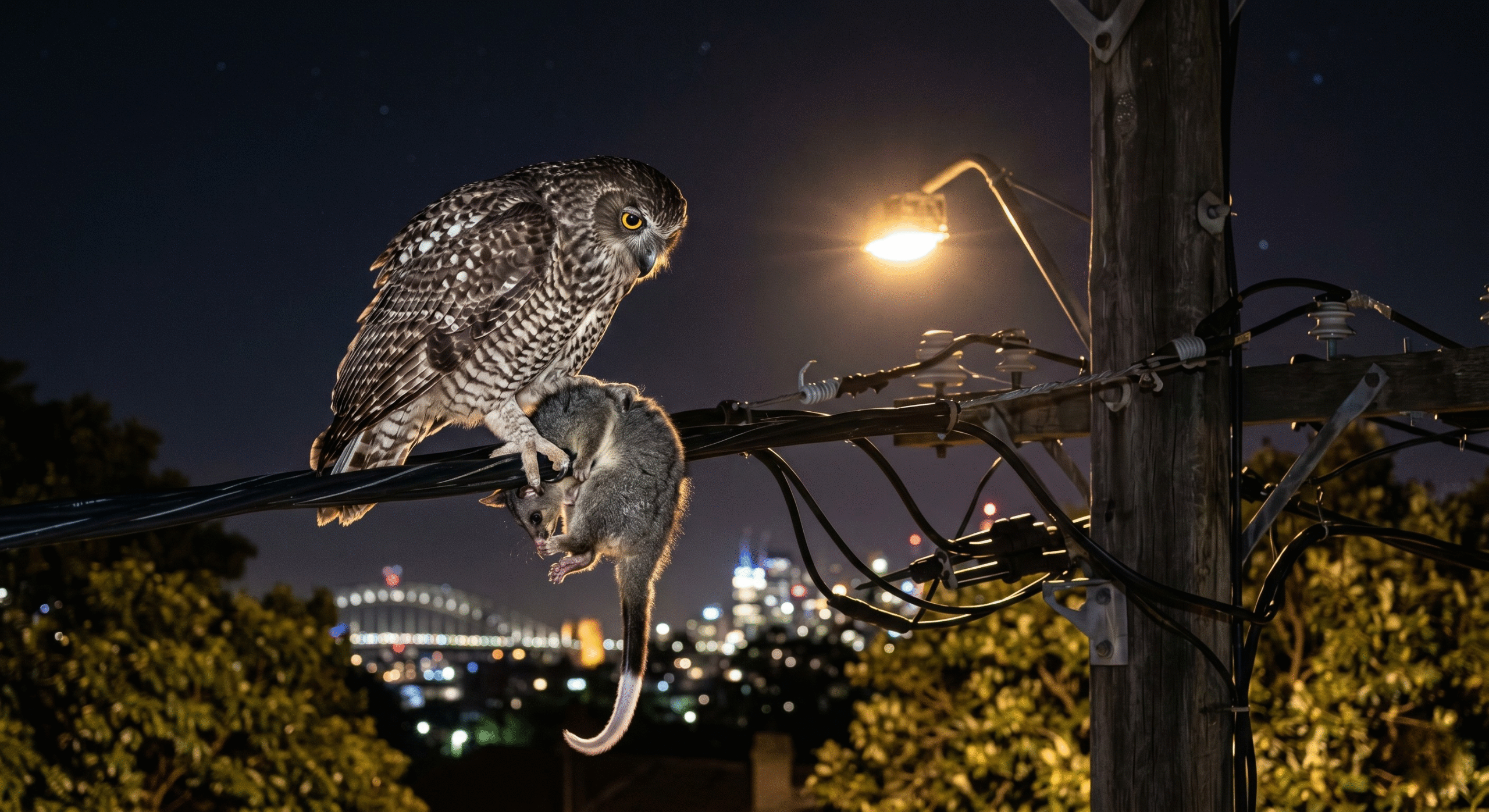
It’s easy to miss the wild world happening right above our heads. Matt was driving through Sydney when his headlights caught something odd. In the dim glow of the streetlights, a shape dangled from the wires overhead.
As he got closer, the “branch” took shape. It wasn’t wood at all. It was a Powerful Owl—Australia’s largest owl species—locked in a literal life-or-death struggle with a common ringtail possum.
A Three-Way Tussle
This wasn’t just a simple hunt. It was what Matt described as a “three-way tussle” between:
- The Predator: The Powerful Owl, a formidable hunter.
- The Prey: The Ringtail Possum, fighting for its life.
- Humankind: Represented by the buzzing, high-voltage power lines that served as the “battlefield.”
The Science Behind the Stumble
You might wonder: What on earth was an owl doing hanging off a power line?
According to Dr. Holly Parsons from BirdLife Australia, this isn’t just a freak accident; it’s a byproduct of urban living. Dr. Parsons, who specializes in how these majestic birds navigate our concrete jungles, explained that the power lines act like a “highway” for possums.
Why Power Lines?
- The Possum’s Path: Ringtail possums often use power lines to move between trees, avoiding ground-level predators like cats or foxes.
- The Owl’s Opportunity: Powerful Owls are smart. They know where the food is. They stalk these “highways” from the shadows.
- The Slip-Up: Dr. Parsons suggests the owl likely swooped in to grab the possum mid-commute. In the ensuing struggle, a wing likely got snagged or the bird intentionally hooked its wing to keep from falling while holding its heavy prize.
Meet the Players
To truly appreciate this scene, we have to look at the two creatures involved. They are icons of the Australian night, but we rarely see them this close.
1. The Powerful Owl (Ninox strenua)
Don’t let the name fool you—it’s actually quite an understatement. These birds are the apex predators of the Australian night sky.
- Size: They can grow up to 60cm tall with a wingspan of 140cm.
- Diet: They are “specialist” hunters, meaning they primarily go after arboreal (tree-dwelling) mammals like possums and gliders.
- Urban Living: Despite being a forest species, they have become incredibly adaptable, moving into Sydney’s leafy suburbs where the “possum buffet” is always open.
2. The Ringtail Possum
The underdog of this story. These guys are smaller than their brush-tail cousins and are known for their long, white-tipped tails which they use like a fifth limb to grip branches—or power lines.
The “Wing-Hanging” Mystery
When Matt first saw the owl, it looked like it was in trouble. Its wing was draped over the wire, and it seemed stuck. In the world of urban wildlife, power lines are usually a death sentence due to electrocution.
However, Dr. Parsons noted that this photo actually highlights the incredible adaptability of these birds. Whether the owl slipped during the struggle or used the wire as a temporary anchor, it showed a bird that wasn’t panicked, but rather one that was figuring out how to navigate a human-made obstacle with a heavy meal in its claws.
The Great Escape
Matt Arnold did exactly what a responsible nature-lover should do: he called for help. He contacted a volunteer rescue service to seek advice on how to help the seemingly “tangled” bird.
But as it turns out, the Powerful Owl didn’t need a rescue mission.
As if sensing the audience, or perhaps just finally getting its grip right, the owl shifted. With the ringtail possum still firmly clamped in its talons, the owl untangled itself, took flight, and disappeared into the darkness of the Sydney night.
Talk about a dramatic exit.
What This Tells Us About Urban Wildlife
This encounter is a vivid reminder that we don’t live “separate” from nature; we live right in the middle of it.
Key Takeaways from the Encounter:
- Adaptation is Key: Wild animals are learning to use our infrastructure for their own benefit (even if it gets a bit messy).
- The Importance of “Green Corridors”: The fact that Powerful Owls are in Sydney at all is a sign that our suburban trees and parks are vital ecosystems.
- Eyes Up: We spend a lot of time looking at our phones or the road. Matt’s story is a reminder to look up every once in a while—you might just see a prehistoric-looking predator performing acrobatics on your local street corner.
How You Can Help Sydney’s Owls
If you’re lucky enough to live in an area with these majestic birds, here are a few ways to keep them safe:
- Plant Native: Keep those big old trees! They provide nesting hollows for owls and homes for the possums they eat.
- Watch the Rodenticide: Avoid using “second-generation” rat poisons. If an owl eats a poisoned rat, it can become secondary-poisoned itself.
- Keep Your Distance: If you see an owl hunting, give it space. They are amazing to watch, but they have a job to do!