When we talk about climate change, we often focus on melting glaciers or rising city temperatures. But for the nation of Kiribati, a collection of 33 islands scattered across the central Pacific, climate change isn’t just about the weather—it’s about the “bank account” of the entire country.
That bank account is filled by one thing: Tuna.
The Giant of the Pacific
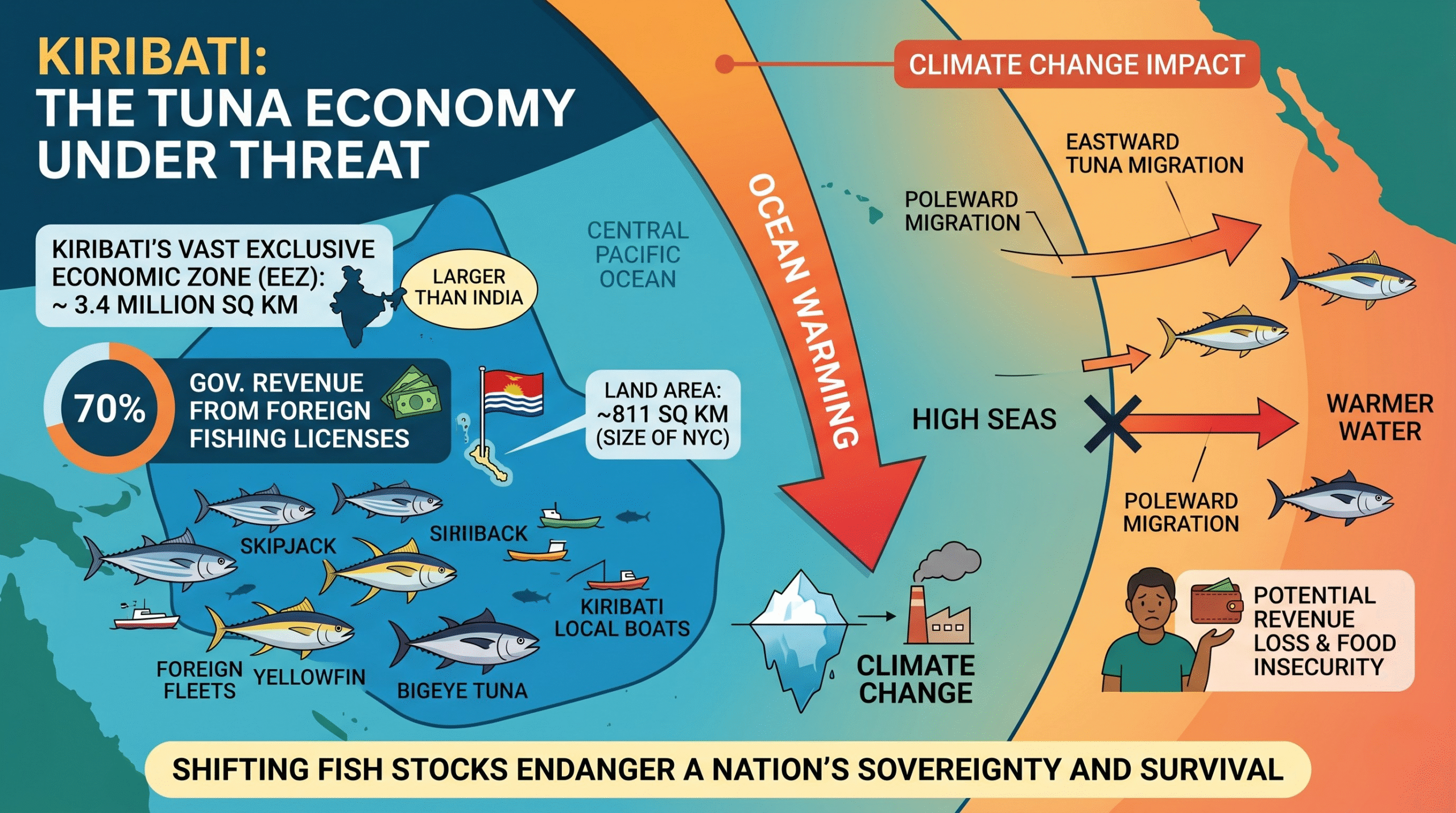
To understand the scale of the problem, you first have to understand just how “big” Kiribati is. If you look at a map, the actual land of Kiribati is tiny—roughly the size of New York City. However, because its islands are so spread out, Kiribati controls an Exclusive Economic Zone (EEZ) that is over 3.4 million square kilometers.
To put that in perspective:
- Land Area: ~811 sq km
- Water Area: ~3,400,000 sq km (Bigger than the entire country of India!)
Within these waters lies a “blue gold mine.” Kiribati’s EEZ is one of the most productive fishing grounds on Earth, home to massive populations of skipjack, yellowfin, and bigeye tuna.
A Nation Dependent on a Single Fish
Most countries have diverse economies—tourism, manufacturing, tech, or farming. Kiribati is different. More than 70% of the government’s total revenue comes from selling fishing licenses to foreign fleets (like those from Japan, Korea, and the EU) so they can catch tuna in Kiribati’s waters.
This money pays for schools, hospitals, roads, and clean water. In short, if the tuna leave, the country’s ability to function leaves with them.
The “Great Migration” of the Tuna
Tuna are the goldilocks of the ocean; they like their water temperature “just right.” As climate change warms the Pacific Ocean, the specific thermal layers that tuna prefer are shifting.
Historically, the nutrient-rich, cooler waters of the Western and Central Pacific have been the perfect home. But as the ocean absorbs more heat, these tuna populations are moving eastward and poleward into the high seas—areas outside of Kiribati’s jurisdiction.
The Economic Domino Effect
What happens when the fish move out of the EEZ?
- Lower License Value: Foreign fleets won’t pay millions of dollars for the right to fish in Kiribati’s waters if the fish are actually located further east in international waters.
- Budget Shortfalls: With 70% of the budget tied to these licenses, even a 10-15% drop in tuna presence could lead to a national financial emergency.
- Food Security: It’s not just about the government’s wallet. Local Kiribati fishermen rely on these stocks for daily protein. As tuna move to deeper, cooler waters further offshore, small local boats can’t reach them safely.
The Double Whammy: Sea Level Rise
While the fish are moving away, the ocean is moving in. Most of Kiribati sits just a few meters above sea level. This creates a heartbreaking irony: the same ocean that provides the nation’s wealth is also threatening to submerge its land, all while the primary source of income (tuna) is migrating away from the people who need it most.
How Can the Pacific Respond?
The islands of the Pacific aren’t just sitting back; they are fighting for “Climate Justice.” Some of the strategies include:
- Vessel Day Schemes: Pacific nations work together to set prices for fishing days, ensuring they aren’t undercut by one another.
- Climate-Proofing the Economy: Trying to find new ways to earn revenue, such as sustainable tourism or seaweed farming, though nothing currently matches the scale of tuna.
- International Legal Battles: Small island states are pushing for global carbon emission cuts to slow the warming of the oceans.
Why This Matters to You
You might be reading this thousands of miles away, but the tuna in your pantry likely traveled through the waters of Kiribati. The story of this Pacific nation is a preview of the “economic migration” that climate change will cause globally.
When ecosystems shift, economies shatter. Protecting the Pacific isn’t just about saving a beautiful travel destination; it’s about protecting a global food source and the sovereignty of a people whose entire livelihood is swimming away to cooler waters.